
Every property owner wants to maximize rental income.
We do too.
As property managers, our goal is always to help owners achieve the highest rent the market will support.
But there is a big difference between maximizing rent and overpricing a property.
One of the most common conversations we have with owners sounds something like this:
“I know you said the market rent is around $1,900, but let’s try $2,100 and see what happens.”
At first glance, it doesn’t sound unreasonable.
It’s only $200 more per month.
Unfortunately, that extra $200 often becomes one of the most expensive decisions a rental property owner can make.
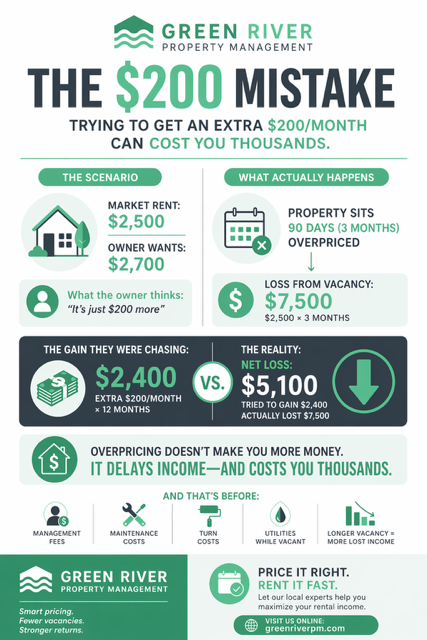
Let’s Do the Math
Imagine your property’s true market rent is:
$1,900 per month
You decide to list it for:
$2,100 per month
The goal?
An extra $200 per month.
Over a full year, that would generate:
$200 × 12 months = $2,400
Sounds great, right?
Now let’s look at what often happens in today’s rental market.
The Reality of Overpricing
When a property is priced above market value, prospective tenants compare it to every other available property in the area.
If similar homes or better homes are available for less money, those homes get the showings.
Those homes get the applications.
Those homes get rented.
Meanwhile, your property sits.
Typically, owners don’t immediately reduce the price to market value.
Instead, they gradually lower the rent:
- First reduction: $50
- Second reduction: $50
- Third reduction: $50
- Fourth reduction: $50
Eventually, the property reaches the actual market rent.
The problem is that this process often takes months.
The Cost of Vacancy
Let’s assume your property sits vacant for three months before finally reaching the correct rental price.
Three months of vacancy at $1,900 per month equals:
$5,700 in lost rent
The owner was trying to gain:
$2,400 annually
But instead lost:
$5,700 immediately
That’s a net loss of:
$3,300
And that’s before considering:
- Utilities while vacant
- Lawn maintenance
- Pool service
- Turn costs
- Additional marketing time
- Mortgage payments
- Insurance
- HOA fees
The actual loss is often much higher.
Prime Rental Season Matters
In Northeast Florida, our strongest rental season typically runs from approximately:
May 15 through August 15
During this period, properly priced homes in good condition can often attract strong activity quickly.
In many cases, we see market-priced properties rent within days rather than months.
When a property sits vacant during peak rental season because it is overpriced, owners aren’t just missing income.
They’re missing their best leasing opportunities of the year.
Once peak season passes, demand naturally begins to soften.
Now the property faces an even greater challenge.
The Market Doesn’t Care About Your Financial Goals
This may be the hardest truth for some investors to hear.
The market does not determine rent based on:
- Your mortgage payment
- Your cash flow goals
- Your desired return
- Your personal financial needs
The market determines rent based on competition.
If comparable properties are renting for $1,900, tenants are unlikely to pay $2,100 simply because the owner wants an additional $200 per month.
The market doesn’t negotiate.
It responds.
What About Rent Increases?
Here’s something many owners overlook.
Let’s say you rent the property at the correct market rate of $1,900.
If the tenant stays and renews, many lease renewals support annual increases.
For example:
- Year 1: $1,900
- Year 2: $1,975
- Year 3: $2,050
- Year 4: $2,125
Over time, market adjustments naturally help owners increase rental income while avoiding costly vacancy.
By pricing correctly from the beginning, owners often earn more money overall than those who chase unrealistic pricing and experience extended vacancy.
Today’s Market Is Different
Years ago, owners could sometimes push rental rates higher simply because inventory was limited.
Today’s market is different.
Tenants have more options.
New construction rentals are entering the market.
Institutional investors continue to offer highly updated homes.
Many local investors have renovated their properties to remain competitive.
As a result, tenants have choices.
When they have choices, pricing matters.
Smart Investors Focus on Occupancy
The most successful investors understand a simple principle:
Occupancy drives profitability.
A property earning rent today is usually far more profitable than a property waiting months for a tenant willing to pay a little more.
The goal is not to achieve the highest possible asking rent.
The goal is to achieve the highest sustainable income with the least amount of vacancy.
Those are two very different strategies.
The Green River Approach
At Green River Property Management, we don’t pull rental pricing out of thin air.
We analyze:
- Current market conditions
- Comparable rentals
- Property condition
- Neighborhood demand
- Seasonal trends
- Competing inventory
Our goal is simple:
Price the property where it will attract qualified tenants, minimize vacancy, and maximize long-term returns.
Because trying to gain an extra $200 per month should never cost you thousands.
Price it right. Rent it fast. Maximize your return.
Green River Property Management
Serving Northeast Florida
904-807-8331
GreenRiverPM.com